
The concept of the self is one of the most profound considerations of human existence. Who are we? What defines our identity? These questions have occupied philosophers, theologians, and spiritual seekers for centuries. Among the myriad perspectives, Buddhism offers an intriguing and transformative understanding of the self — one that challenges conventional ideas and invites individuals to explore the deeper dimensions of existence.
The Illusion of the Self
Central to Buddhist philosophy is the idea that the self, as we commonly conceive it, is an illusion. In Western thought, the self is often viewed as a permanent, unchanging essence — the core of who we are. Buddhism, however, refutes this notion through the doctrine of “anatta” or “non-self.” According to this teaching, there is no fixed or immutable self underlying our experiences. Instead, what we call the “self” is a collection of transient phenomena: thoughts, emotions, sensations, and perceptions.
Buddhist teachings liken the self to a flame or a flowing river — constantly changing and never the same from one moment to the next. This perspective is not meant to negate the existence of individuality but to highlight the impermanent and composite nature of our being. By recognizing the illusion of a fixed self, we can begin to loosen our attachment to ego and foster a sense of liberation.
Anatta and the Five Aggregates
To further elucidate the nature of the self, Buddhism introduces the concept of the Five Aggregates, or “skandhas.” These are the components that constitute human existence:
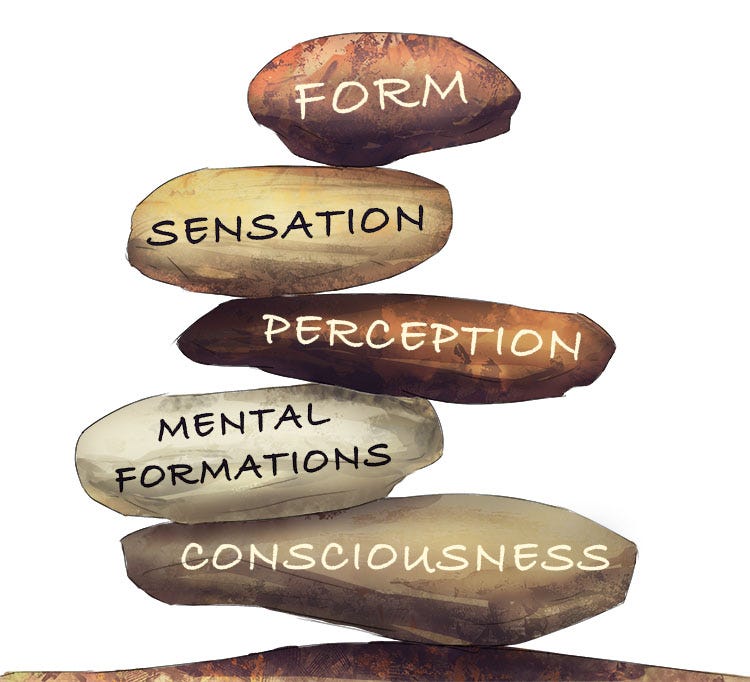
Form (Rupa): The physical body and material phenomena.
Sensation (Vedana): The feelings and sensations we experience, whether pleasant, unpleasant, or neutral.
Perception (Sanna): The ability to recognize and interpret objects and experiences.
Mental formations (Sankhara): The thoughts, intentions, and habits that shape our behaviour.
Consciousness (Vinnana): The awareness of experiences and phenomena.
These aggregates interact and give rise to the illusion of the self, but none of them is the self in isolation or permanence. Together, they embody the transient and interconnected nature of existence.
The Buddhist Path to Understanding the Self
Buddhism is not merely a theoretical framework; it offers practical tools and paths to deeply experience the teachings of non-self. The journey begins with mindfulness and meditation, which help individuals observe the workings of the mind and body without judgment or attachment. Mindfulness, or “sati,” is a cornerstone of Buddhist practice. It involves paying attention to the present moment with clarity and awareness. Through mindfulness meditation, practitioners can observe the impermanent nature of thoughts, emotions, and sensations. This awareness cultivates insight into the non-self, revealing the transient and dependent nature of our experiences. Vipassana, or insight meditation, takes this practice a step further. It encourages a deep exploration of the Five Aggregates and the interconnectedness of all phenomena. This insight leads to a profound understanding of anatta, freeing individuals from the grip of ego and self-centred thinking.
The concept of non-self is closely tied to the Buddhist principle of letting go of attachment. Attachment to the self — as well as to material possessions, status, and relationships — is considered a source of suffering. By recognizing the illusory and impermanent nature of the self, individuals can release their clinging to identity and ego. This letting go does not mean indifference or detachment from life. Rather, it is an invitation to engage with the world in a more compassionate and open-hearted way. Without the constraints of self-centeredness, individuals can connect with others and the world around them more authentically.
The Buddhist understanding of the self offers profound implications for contemporary society. In a world often dominated by individualism and ego-driven pursuits, the teachings of anatta challenge us to reconsider our priorities and values. Ego is often at the root of conflicts, insecurities, and anxieties. The belief in a fixed self can lead to defensiveness, competition, and a fear of loss. By embracing the concept of non-self, individuals can transcend these limitations and cultivate a sense of peace and interconnectedness.
The recognition of non-self also encourages compassion. When we see others as part of the same interconnected web of existence, it becomes easier to empathize and act with kindness. Compassionate action arises naturally when the barriers of ego dissolve.
Finding Liberation
Ultimately, the Buddhist perspective on the self is a path to liberation. By letting go of the illusion of self, individuals can experience profound freedom and joy. This liberation is not about escaping life but about embracing it with clarity and equanimity. The Buddhist teachings on the self invite us to question our assumptions and explore the deeper truths of existence. By recognizing the illusion of the self and embracing the principles of anatta, we can transcend ego-driven suffering and connect with a greater sense of peace and compassion. In doing so, we embark on a journey of self-discovery that is not about finding ourselves but about realizing the interconnected and impermanent nature of all things. Buddhism reminds us that liberation lies not in clinging to identity but in letting go — a practice that can transform not only our lives but the world around us.
The integration of Buddhism, Internal Family Systems (IFS), and Eye Movement Desensitization and Reprocessing (EMDR) creates a multidimensional framework for healing that addresses the mind, body, and spirit. Buddhism’s emphasis on mindfulness and the principle of non-self (anatta) aligns with IFS’s exploration of inner parts, allowing individuals to observe their internal family of parts without judgment, thus fostering self-compassion and non-attachment. EMDR complements this by processing and releasing trauma stored in the body and nervous system, liberating individuals from past pain that keeps parts of their psyche trapped in defensive roles. Together, these approaches offer a harmonious synthesis: Buddhism provides the meditative tools and spiritual grounding, IFS offers a roadmap for understanding and harmonizing inner conflicts, and EMDR facilitates the resolution of deeply rooted trauma. This integration empowers individuals to heal holistically, cultivate inner peace, and embrace interconnectedness in their journey toward well-being.